The history of the Palais
First of all: the Palais is not the Upper Castle
It is important to make this clear from the beginning: the Palais of Villar Focchiardo is not the Upper Castle of Villar Focchiardo, also known as the Castle of the Counts Carroccio.
They are two distinct places, both linked to the historical memory of the area, but with different origins, functions and stories.
The Palais is the ancient fortified house of the village, connected with the medieval memory of Villar Focchiardo, the routes of the Susa Valley and the presence of the Viscounts of Baratonia. The Upper Castle belongs to a later phase of local history and developed as a fortified and noble residence in a different context.
This distinction is essential. The Palais must not be described as a mere dependency or extension of the castle. It has its own identity, its own historical layers and its own memory, still preserved today in its stones, rooms, furnishings and the many signs left by the passing centuries.
The origins of the fortified house
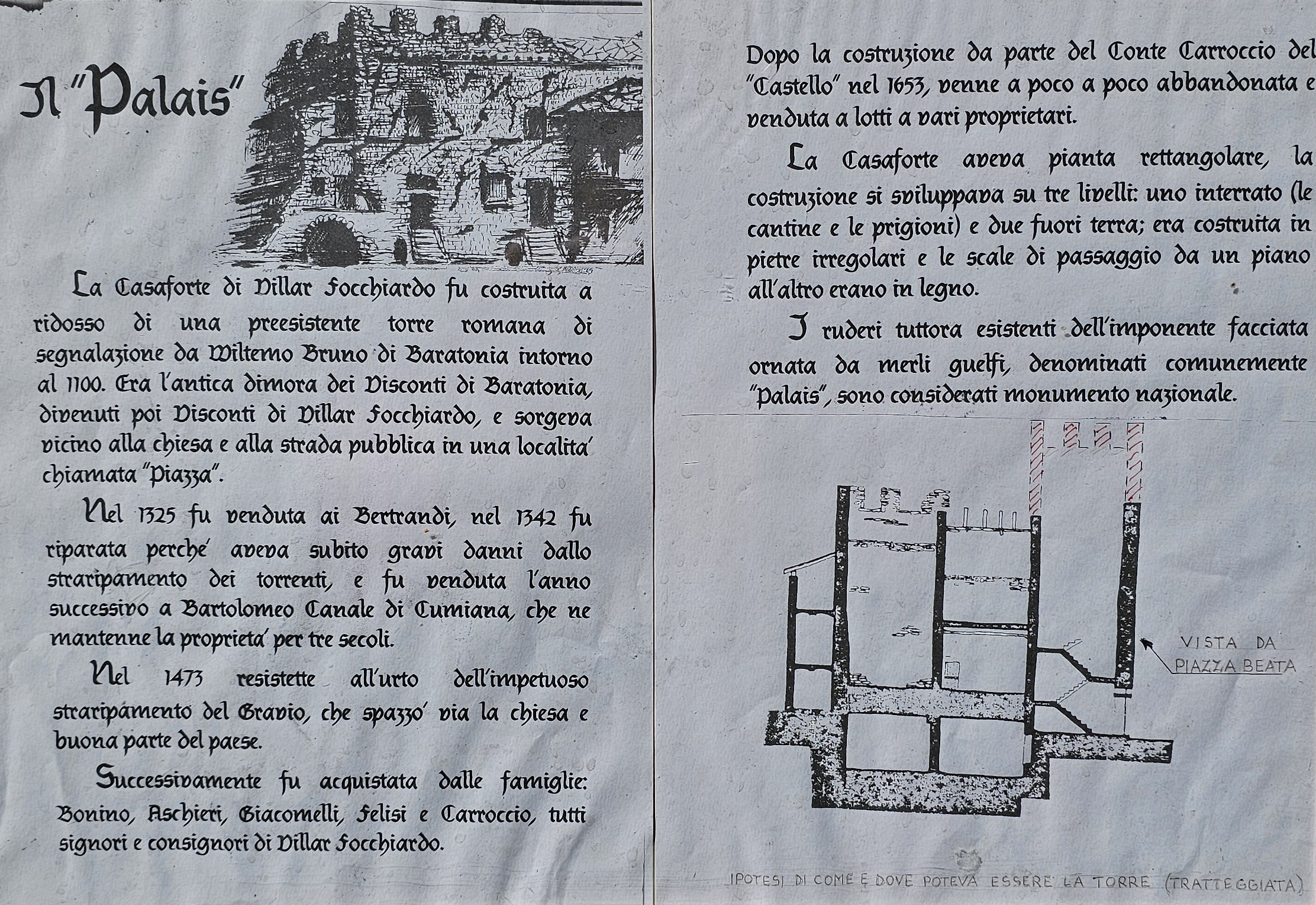
Local sources place the origins of the Palais around the year 1000 and, more specifically, around 1100. The fortified house is said to have been built by Guglielmo Bruno di Baratonia close to a pre-existing Roman signalling tower, in an area of the village near the church and the public road, in a place called “Piazza”.
It was the ancient dwelling of the Viscounts of Baratonia, who later became the Viscounts of Villar Focchiardo. Its role was therefore not simply residential: it was a place of defence, control and representation, set in a territory of clear strategic value along the routes of the Susa Valley.
The stone itself tells this ancient origin. Some wall sections still preserve a severe and essential laying technique, typical of medieval defensive architecture: irregular stones arranged according to a practical rather than decorative logic, built to resist, protect, mark boundaries and watch over the land.
The passing of centuries inside the house
What makes the Palais especially fascinating is not only its age, but the possibility of reading different historical periods within the same structure.
The visitor does not stand before an artificially reconstructed building or a scenic imitation. The Palais still preserves the imprint of a house that has been lived in, altered, adapted, preserved and crossed by generations for centuries.
Its oldest masonry recalls the medieval phase of the fortified house. In some areas, the stone still speaks of the solidity of the year 1000 and the centuries immediately following. Moving through the rooms, other layers emerge: modified openings, internal passages, transformed rooms, stairs, vaults, cellars, attics and service areas.
Particularly precious are the portions of fifteenth-century frescoes and decorations brought back to light during the conservative recovery work. These are not reconstructed decorative cycles, but authentic fragments: surviving traces of colour and memory that allow us to imagine the dignity and decorative richness once present in some rooms.
Ownership, repairs and survival
In 1325 the fortified house was sold to the Bertrandi family. In 1342 it was repaired after suffering serious damage caused by flooding torrents; the following year it was sold to Bartolomeo Canale di Cumiana, whose family kept the property for about three centuries.
In 1473 it withstood the violent flooding of the Gravio stream, which swept away the church and a large part of the village. This episode helps portray the Palais as a deeply rooted and solid structure, capable of surviving one of the most traumatic events in local memory.
Later, the Palais was acquired by several families, including Bonino, Aschieri, Giacomelli, Felisi and Carroccio, all lords and co-lords of Villar Focchiardo.
The castle of 1653 and the gradual abandonment
After the construction of the Castle by Count Carroccio in 1653, the Palais was gradually abandoned and sold in lots to various owners.
This is one of the reasons why the Palais and the Upper Castle are sometimes confused. They are, however, two different buildings: the Palais preserves the older memory of the fortified house, while the Castle belongs to a later phase of the noble history of the territory.
The structure of the fortified house
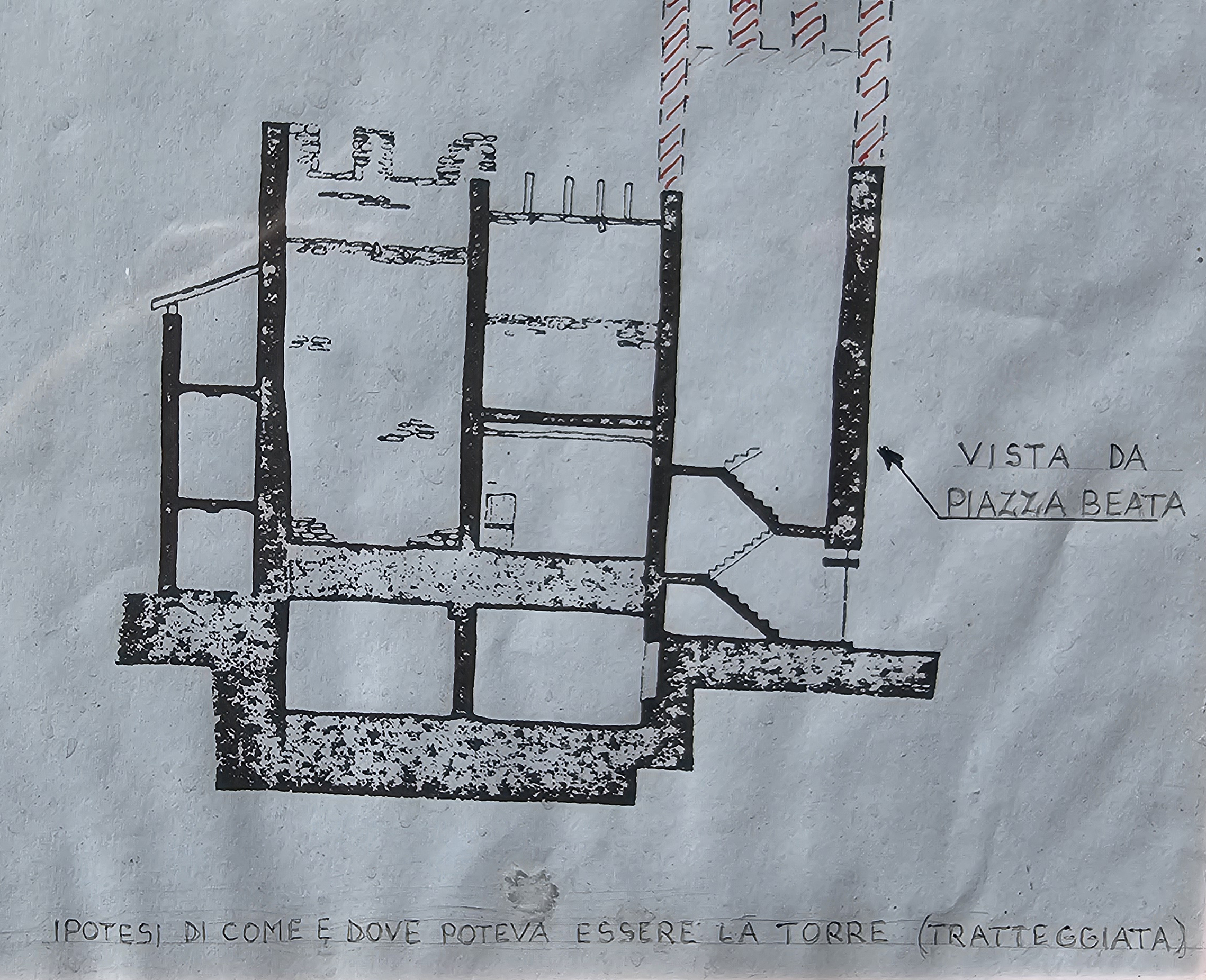
The fortified house had a rectangular plan and developed over three levels: an underground level, with cellars and prisons, and two above-ground floors. It was built with irregular stones, and the stairs connecting one level to another were originally wooden.
The surviving remains of the imposing façade, decorated with Guelph battlements and commonly called “Palais”, are considered an important monumental testimony to local history.
Furnishings, tools and objects through the centuries
Inside the Palais, time is not told only by the walls. It is also told by furnishings, objects, tools, household items, chests, papers and fragments of everyday life preserved in the rooms.
The house keeps objects and traces covering a very wide period: from the fifteenth century to the early decades of the twentieth century. Each element helps reveal a layered dwelling, inhabited by different generations and shaped by changing uses, needs and habits.
There are authentic furnishings, domestic objects, tools and materials that speak of daily life, work, school, family, devotion, war and memory.
Cellars, attics and discoveries
The cellars of the Palais have a very special atmosphere. These are deep, material spaces, marked by stone, humidity, darkness and silence. Objects and finds have been discovered there, including materials connected with the First and Second World Wars.
Particularly evocative are the large attics, not yet restored. They are suspended spaces, still partly unexplored, preserving chests, papers, documents, school materials, diaries, registers and memories dating from the eighteenth century to the early twentieth century.
In these rooms, time seems to have settled slowly. Yellowed papers, old school diaries and forgotten objects tell not only the history of the Palais, but also that of the people who lived in it, crossed it, inhabited it and handed it down to the present.
The floor plan of the old fortified house
The reproduction of the historical plan of the old fortified house helps us understand the original structure of the Palais and its relationship with the ancient fabric of Villar Focchiardo.
The plan shows the layout of the building, its rectangular structure, the hypothesis of the original tower and the position of the façade as seen from Piazza Beata. It is a valuable tool for reading the Palais not only as a dwelling, but as an architectural organism born in a medieval context and transformed over the centuries.
The Palais today
Today the Palais should not be described as an abandoned place. It is a private historic residence undergoing enhancement and recovery, with a conservative approach that aims to respect the identity of its rooms and preserve their authentic character.
The restoration does not erase the past, cover it or turn it into an artificial reconstruction. On the contrary, it accompanies the house toward a new life while keeping its layers, imperfections, wounds and signs visible.
Legends, presences and popular memory
Alongside documented history, the Palais also preserves a subtler heritage: local legends, stories handed down over time and sensations reported by those who have walked through its rooms.
Among these stories, the most evocative is that of the White Girl, a figure linked to the internal staircase and to a nineteenth-century event. A story that unites memory, sorrow, mystery and documentation, and still accompanies the Palais as a discreet and fragile presence.
Over time, sudden noises, sharp knocks, tremors, cold sensations and unexpected perceptions have also been reported. Whether interpreted as suggestion, memory of place or manifestations of mystery, these accounts have become part of the identity of the Palais.